


Honey Hair Mask: Benefits, How to Use Raw Honey & 5 DIY Recipes
Raw honey works as a natural humectant for hair. Five simple DIY mask recipes for shine, softness, and moisture, plus how to apply them and what to expect.


Honey does not spoil the way other foods spoil. Bacteria and mold cannot establish themselves in it, and a sealed jar stored in a cool, dry place will still be good years after you bought it. That part of the folklore holds up.
But "never spoils" is not quite the same as "indestructible." Honey can ferment if it takes on moisture, and it slowly loses aroma and delicate compounds with heat and time. Neither of those is bacterial spoilage. They are moisture and chemistry.
The practical takeaway: honey is one of the most stable foods you can pack. It needs no refrigeration, no ice, and no cold chain. It just needs to stay sealed and out of direct heat.
Most foods go bad because something living eats them first. Bacteria, yeasts, and molds need available water, and most foods hand it to them freely.
Honey does not. It is a supersaturated sugar solution: so much sugar dissolved in so little water that the water is effectively locked away, chemically unavailable to microbes. Add a naturally low pH and a couple of other mechanisms, and you have a food that actively resists being colonized.
This is not marketing. Researchers who stored a collection of honey samples for roughly fifteen years found that nearly all of them still showed measurable antimicrobial activity when tested (Fernandes et al., 2024). The honey had aged. It had not gone bad.
Everything above adds up to a food with an unusual set of properties for a suitcase.
No cold chain. Honey needs no refrigeration, no ice pack, and no insulated bag. It is remarkably stable at room temperature when properly sealed, which is more than can be said for almost anything else you would want to eat on a trip.
Nothing to go rancid. Honey contains essentially no fat and no protein of consequence, so it has no rancidity pathway. Nuts go stale, bars turn oily, dairy is a liability. Honey has none of those failure modes.
Fast, uncomplicated carbohydrate. Honey is a straightforward source of carbohydrate, mostly fructose and glucose, which is useful on a long travel day, a hike, or a morning when breakfast did not happen. That is a compositional fact, not a performance claim.
It fixes bad coffee. A real and underrated benefit of hotel rooms and campsites everywhere.
The catch is logistics. A glass jar in checked luggage is a bad plan, and airport security treats honey as a liquid or gel rather than a solid, which is exactly the problem single-serve portioning solves.
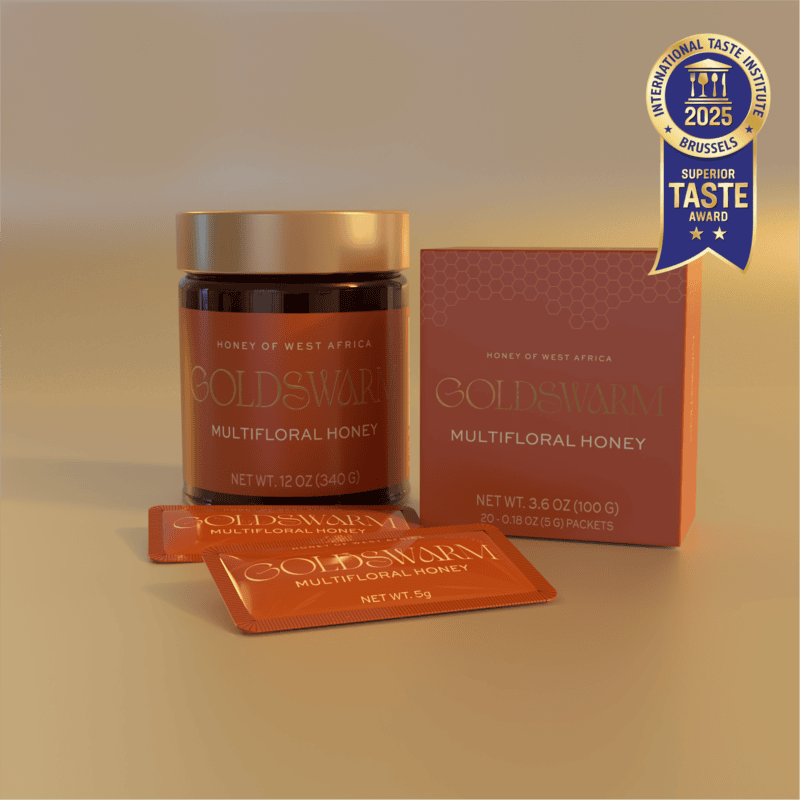
Goldswarm To-Go Packets are single-serve portions of the same raw, single-origin West African wildflower honey. Sealed, spill-proof, and sized for a pocket or a carry-on.
If it crystallizes, warm it gently. A warm (not hot) water bath will re-liquefy it. High heat degrades quality.

No single mechanism explains honey's stability. Four of them stack.
Water activity (written as aw) measures how much water in a food is actually free for microbes to use, which is a different question from how much water the food contains. Honey typically has enough sugar to pull aw down into a range where yeast and bacterial growth are effectively suppressed.
This is the primary barrier, and it is also the one that can fail. Water activity tracks with moisture content, but the relationship is not perfectly linear and varies with sugar composition (Chen, 2019). This is why beekeepers care about moisture at harvest, and why an open jar in a humid kitchen is a genuine risk: honey is hygroscopic and will pull water out of the air.
Honey is mildly acidic, largely from gluconic acid produced during ripening. On its own, that acidity would not preserve much. Combined with low water activity, it narrows the range of organisms that could survive there to almost nothing.
Bees add an enzyme called glucose oxidase to nectar. When honey is diluted, that enzyme converts glucose into gluconic acid and hydrogen peroxide, the same compound in the brown bottle in your medicine cabinet, at far lower concentration. In an undiluted jar the reaction is largely dormant. Introduce water, and it becomes an active defense (Bucekova et al., 2018).
It is a rather elegant system: the very thing that would threaten the honey is what switches on the response.
Honey carries phenolics and flavonoids picked up from the nectar the bees foraged. These vary enormously by floral source, and they interact with the hydrogen peroxide pathway rather than acting alone (Bucekova et al., 2018). This is one reason honey from different forage produces different results in the lab, and part of why single-origin matters as more than a label.
Three things. None of them are what most people picture when they hear "spoiled."
Every jar of raw honey contains dormant sugar-tolerant yeasts. They arrive with the bees and they are entirely normal. As long as water activity stays low, they sit there doing nothing.
Raise the moisture through poor sealing, humid storage, or a wet spoon, and they wake up. The result is fizzing, a sour or winey smell, and sometimes foam on the surface. That is fermentation, and it is the main spoilage risk for properly stored honey. It is also almost always preventable with a tight lid.
Honey turning grainy, cloudy, or solid is not a problem. It is glucose coming out of solution, which is what a supersaturated sugar solution does eventually. Raw, unfiltered honey tends to crystallize sooner because pollen and wax particles give the crystals something to form on.
Worth knowing, though: crystallization and fermentation are linked. When glucose crystallizes out, the liquid left behind holds proportionally more water, which can locally raise water activity enough for yeasts to activate. Crystallized honey stored in a hot, humid place for a long time is the scenario to avoid. Crystallized honey in a sealed jar in a cupboard is simply crystallized honey.
Honey degrades gradually. Aroma compounds volatilize, enzymes lose activity, color darkens, and a marker compound called HMF accumulates, faster at higher temperatures and over longer storage (da Silva et al., 2016).
This is quality loss, not safety loss. Old honey is not dangerous. It is just less interesting than it was. And it is the strongest practical argument for keeping honey out of a hot car and away from the stovetop.
Raw honey does not behave like the clear, uniform product most people grew up with. It is thicker, and it carries fine suspended particles that catch the light rather than passing it through. On the tongue it coats more slowly and releases flavor over a longer arc.
As it crystallizes, the texture shifts from pourable to spreadable to firm, and the mouthfeel changes with it, from a slow-moving syrup to something closer to a soft paste that dissolves gradually. That progression is not decline. It is the same honey, doing what a supersaturated sugar solution does when left alone.
Do not give honey to infants under 12 months. Honey can contain dormant Clostridium botulinum spores. An adult digestive system handles them without incident; an infant's may not, which can result in infant botulism. This is unrelated to honey quality, brand, or processing. It applies to all honey, raw or otherwise. Guidance from the CDC and pediatric bodies is consistent and unambiguous on this point.
Honey does not spoil microbially, and a sealed jar stored properly stays good indefinitely. Any "best by" date on the label reflects peak flavor and aroma, not safety. Quality does decline slowly with heat and time.
It circulates widely, and we have not been able to trace it to a documented, peer-reviewed analysis. Treat it as folklore. The better-supported evidence is more recent and more useful: honey samples held in storage for roughly fifteen years retained measurable antimicrobial activity under laboratory testing (Fernandes et al., 2024).
No. Crystallization is a normal physical change, not spoilage. Warm the jar gently in a water bath to return it to liquid.
Look for bubbles, foam on the surface, a bulging lid, or a sour, alcoholic, or winey smell. Fermented honey is generally not dangerous to a healthy adult, but the flavor is off and it should be discarded.
Airport security treats honey as a liquid or gel, so a full jar in a carry-on is subject to the standard liquid limits. Single-serve packets are far simpler. We are covering the specific rules in a dedicated post.
Less readily than in hot ones. Cold liquid and viscous honey do not mix easily. There are ways around it, which we cover separately.
No. Both resist microbial spoilage by the same mechanisms. Raw honey tends to crystallize sooner because it retains pollen and fine particles that seed crystal formation, a change in texture, not a change in safety.
Approximate nutrition, per 1 tablespoon (21 g)
| Amount | |
| Calories | ~64 kcal |
| Total carbohydrate | ~17 g |
| Sugars | ~17 g |
| Fat | 0 g |
| Protein | ~0 g |
| Sodium | ~1 mg |
Source: USDA FoodData Central, honey, FDC ID 169640 (SR Legacy, food category: Sweets; NDB 19296). https://fdc.nal.usda.gov/food-details/169640/nutrients ↗
Storage summary
| Variable | Target |
| Storage temperature | Room temperature, out of direct sun |
| Refrigeration | Not recommended |
| Container | Airtight, sealed |
| Primary spoilage risk | Moisture ingress leading to fermentation |
| Crystallization | Normal; reversible with gentle warming |
| Shelf life, sealed and properly stored | Indefinite for safety; flavor peaks earlier |
Sources
1. da Silva, P.M., Gauche, C., Gonzaga, L.V., Costa, A.C.O., Fett, R. (2016). Honey: Chemical composition, stability and authenticity. Food Chemistry, 196, 309–323. https://doi.org/10.1016/j.foodchem.2015.09.051 ↗
2. Fernandes, K.E., Dong, A.Z., Levina, A., Cokcetin, N.N., Brooks, P., Carter, D.A. (2024). Long-term stability and the physical and chemical factors predictive for antimicrobial activity in Australian honey. PLoS ONE, 19(5), e0303095. https://doi.org/10.1371/journal.pone.0303095 ↗
3. Chen, C. (2019). Relationship between water activity and moisture content in floral honey. Foods, 8(1), 30. https://doi.org/10.3390/foods8010030 ↗
4. Bucekova, M., Buriova, M., Pekarik, L., Majtan, V., Majtan, J. (2018). Phytochemicals-mediated production of hydrogen peroxide is crucial for high antibacterial activity of honeydew honey. Scientific Reports, 8, 9061. https://doi.org/10.1038/s41598-018-27449-3 ↗
5. CDC, Infant Botulism. https://www.cdc.gov/botulism/prevention/index.html ↗

