The 30-Second Verdict
-
Honey lemonade is simple, with one catch: honey does not want to dissolve in cold water. Pour it straight into a cold pitcher and it sinks, coils at the bottom, and stays there.
-
The fix is to dissolve the honey first, in a small amount of liquid, before anything cold enters the picture. Two ways to do that: warm the liquid gently (fast, foolproof), or use lemon juice at room temperature and shake hard (slower, keeps the honey unheated).
-
Ratio to remember: 1 part honey, 2 parts lemon juice, 9 parts water. Adjust from there.
Why Honey Lemonade Is Worth the Extra Step
Sugar lemonade is sweet and then it is over. Honey lemonade has somewhere to go — floral notes underneath the acid, a slightly rounder body, a finish that lingers past the sourness instead of stopping dead.
Raw, single-origin honey brings more of this than a blended supermarket product, because the character comes from what the bees actually foraged. Our West African wildflower honey leans warm and floral, which sits well against lemon rather than fighting it.
The trade-off is that honey is thicker and fussier than sugar, and it does not disappear into the background the way sugar does. That is the point.
Texture and Mouthfeel
Honey lemonade has a different body from the sugar version. Where sugar lemonade is thin and clean, hitting sharp and finishing fast, honey lemonade carries more weight across the tongue: a faint viscosity that sugar does not produce even at the same sweetness. The acid arrives first, the sweetness a beat behind, and the floral notes last, after you have swallowed. Path B reads slightly rounder and more integrated, especially after a night in the fridge; Path A is a touch cleaner. Expect a light haze rather than perfect clarity, since raw honey and lemon pulp both carry fine particles. Clear lemonade is filtered lemonade, and filtering takes something out along with the cloudiness.
Path A — Warm-Mixed Honey Lemonade
The reliable one. Ten minutes, no technique required.
Makes about 6 servings (1.4 L / 6 cups)
Ingredients
-
1/2 cup honey (170 g)
-
1/2 cup warm water (120 ml) — warm to the touch, not hot
-
1 cup fresh lemon juice (240 ml, roughly 5–6 lemons)
-
4 cups cold water (950 ml)
-
1/8 tsp fine salt
-
Ice, to serve
Method
-
Make the honey syrup. Combine the honey and warm water in a jar or measuring cup. Stir until completely dissolved and uniform — about a minute. The mixture should be clear, with nothing settled at the bottom. Do not boil, and do not put honey in a pan over direct heat.
-
Juice the lemons. Room-temperature lemons give more juice. Roll them firmly under your palm first. Strain out seeds; leave some pulp if you like it.
-
Combine. Pour the honey syrup and lemon juice into a pitcher. Add the salt and stir.
-
Dilute. Add the cold water. Stir thoroughly.
-
Taste and adjust. More honey syrup if it is too sharp, more lemon if it is flat, a splash more water if it is heavy.
-
Chill, then ice. Refrigerate at least an hour. Serve over ice.
Why the salt. An eighth of a teaspoon across six servings is not enough to taste as salty, but it sharpens the perception of both sweet and sour and makes the whole thing read as more vivid. Skip it and the lemonade tastes slightly muted.
Path B — Fully Cold, No Heat
For anyone who wants the honey to go into the glass exactly as it came out of the jar. Similar result, more effort, no warming step at any point.
Makes about 6 servings (1.4 L / 6 cups)
Ingredients
-
1/2 cup honey (170 g), at room temperature
-
1 cup fresh lemon juice (240 ml), at room temperature
-
4 1/2 cups cold water (1.07 L)
-
1/8 tsp fine salt
-
Ice, to serve
Method
-
Bring both to room temperature. This matters more than anything else in this method. Honey stored in a cool pantry will not cooperate. Lemon juice should not be cold either.
-
Shake, do not stir. Put the honey and lemon juice in a sealed jar with plenty of headspace. Shake hard for 60–90 seconds. Agitation is doing the work that heat does in Path A — breaking the honey into small enough pieces that it can actually dissolve.
-
Check. Hold the jar up. The mixture should be uniform and slightly cloudy, with no clear layer at the bottom. If there is one, shake again. A second round is normal.
-
Combine and dilute. Pour into a pitcher, add the salt, add the cold water, stir well.
-
Rest. Give it two hours in the fridge if you can. Cold-mixed lemonade integrates more slowly and is noticeably better on day two.
If the honey is crystallized, this method will not work — crystallized honey needs gentle warming to return to liquid first, at which point you are effectively on Path A. That is fine. It does not damage the honey.
Blender shortcut. Twenty seconds of blending honey with the lemon juice does the same job as shaking, faster. It will aerate slightly, giving a foamier drink. Some people prefer it.
The Science: Why Honey Fights Cold Water
Three things are happening, and only one of them is the one people expect.
Viscosity Collapses With Temperature
Honey is extraordinarily viscous, and that viscosity is steeply temperature-dependent: a modest increase in temperature produces a large drop in thickness. Cold honey is close to immovable; warm honey pours like syrup. That is the entire dissolution problem. Honey is not insoluble in cold water, it dissolves completely given time and agitation, but a cold, viscous mass has almost no surface area in contact with the water, so the process is glacially slow. Warming it, or breaking it up mechanically, solves this.
Heat Solves One Problem and Creates Another
Warming honey makes it behave, but it also degrades it: aroma compounds volatilize, enzyme activity drops, and a marker compound called HMF accumulates, faster at higher temperatures and over longer exposure. That is why the two paths exist. Path A uses warm water, not hot, enough to thin the honey without cooking it. Path B avoids heat entirely and spends effort instead.
The Cold-Sweetness Myth
You will read that cold suppresses sweetness, so iced drinks need more sweetener. The research is more careful: temperature does modulate sweet taste, but the effect is modest and largest at low sugar concentrations, and lemonade is not dilute. What actually flattens iced lemonade is more boring and more fixable, which is that melting ice dilutes it. Mix slightly stronger than you want it, or freeze lemonade into cubes so the ice dilutes with more lemonade. And taste as you go: lemon juice varies a lot between lemons.
Using Honey Instead of Sugar
If you are converting a sugar lemonade recipe you already like:
Start by replacing 1 cup of sugar with about 2/3 cup of honey, then reduce the added water by roughly 2 tablespoons to compensate for the water honey brings with it (honey is around 17% water by weight).
Two caveats worth stating plainly:
The sweetness ratio is not fixed. Honey is generally sweeter than sugar per gram — the commonly quoted range is somewhere between 1.2 and 1.5 times — but that figure moves depending on the honey's sugar profile, the concentration, and the acidity of what you are putting it into. An acidic lemon beverage is exactly the context where the relationship shifts. Treat 2/3 cup as a starting point and taste.
Honey is not a neutral swap. Sugar contributes sweetness and nothing else. Honey contributes sweetness plus floral character, a faint acidity of its own, and a different mouthfeel. In lemonade this is an improvement. In a recipe built around a clean sugar profile, it is a change you should want.
Nutritionally, honey and sugar are close. Honey has a marginally lower calorie density per gram and trace minerals, but both are concentrated sources of sugar and should be treated that way. Using honey does not make a sweet drink into a health drink.

Approximate Nutrition
Per serving, based on six servings from the Path A quantities. Values from USDA FoodData Central; actual figures vary with floral source and lemon size.
|
Nutrient
|
Per serving (~240 ml)
|
|
Calories
|
~95 kcal
|
|
Total carbohydrate
|
~26 g
|
|
Sugars
|
~26 g
|
|
Fat
|
0 g
|
|
Protein
|
~0.1 g
|
|
Sodium
|
~50 mg
|
|
Vitamin C
|
~16 mg
|
Path B is nutritionally equivalent; the only difference is a slightly higher water volume.
Take the Honey With You
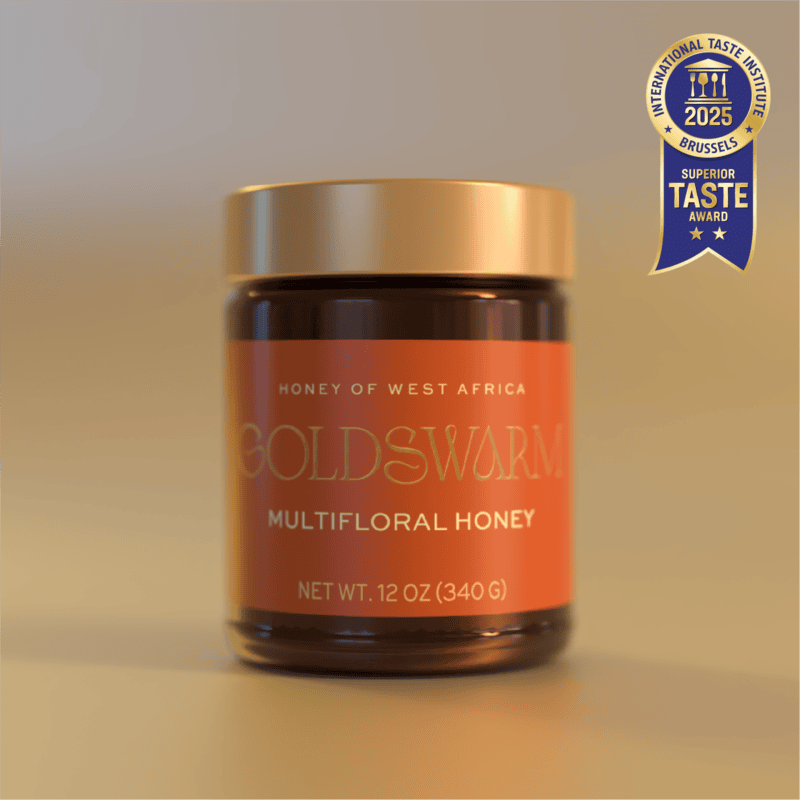
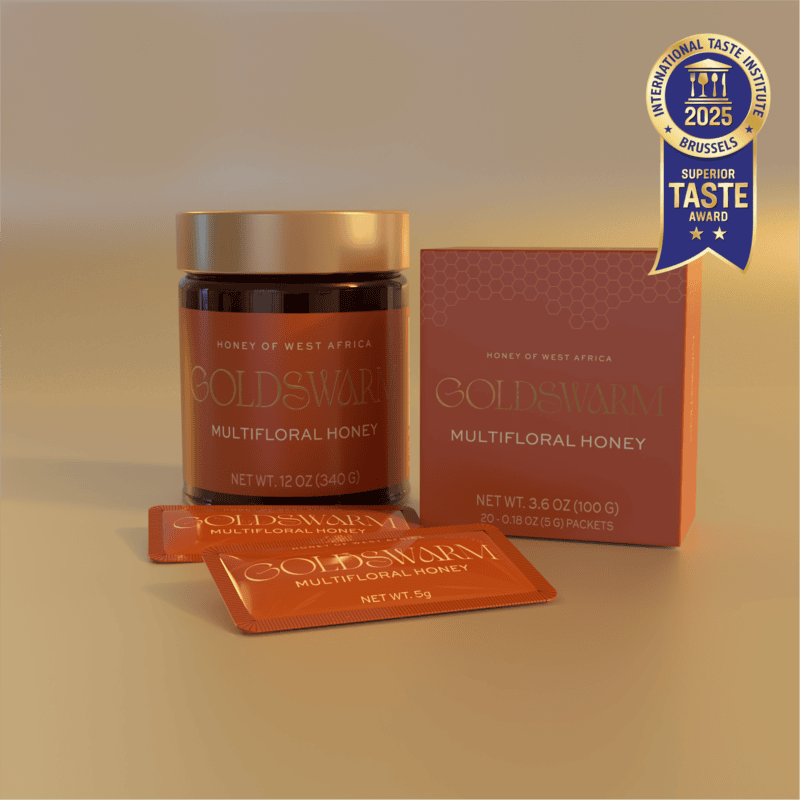
The pitcher stays home. Goldswarm To-Go Packets are single-serve portions of the same raw, single-origin West African wildflower honey — for the version of this you make in a hotel room, at a campsite, or with whatever lemon you can find on the road.
Frequently Asked Questions
Why won't my honey dissolve in cold water?
Because cold honey is extremely viscous and barely makes contact with the water. It is not insoluble — it is slow. Dissolve it in a small amount of warm liquid first, or agitate it hard at room temperature, then add the cold water.
Does warming honey ruin it?
Gentle warming — water that is comfortable to touch — causes minimal change. Sustained high heat is a different matter: it degrades aroma compounds and enzymes and accelerates HMF formation. Never put honey in a pan over direct heat. If you want to avoid warming entirely, use Path B.
Can I use bottled lemon juice?
Yes, although fresh lemon juice will produce a brighter, more aromatic lemonade. Bottled juice is more uniformly acidic but has lost most of the volatile aromatics that make fresh lemonade taste like lemons. If you use it, start with slightly less and adjust.
How long does honey lemonade keep?
Four to five days refrigerated in a sealed container. For the best flavor, enjoy it within four to five days.
My honey has crystallized. Can I still use it?
Yes. Crystallization is a normal physical change, not spoilage. Warm the sealed jar in a bowl of warm water until it returns to liquid, then proceed with Path A.
Can I make it sparkling?
Yes. Make the honey-and-lemon concentrate as written, then top with sparkling water instead of still, and skip most of the dilution water. Add the bubbles at the moment of serving.
Can I give this to a baby?
No. Honey should never be given to infants under 12 months, in any form, because of the risk of infant botulism. This applies to all honey regardless of quality or processing.
Can I make it less sweet?
Reduce the honey to 1/3 cup and add a little more water. Because you are dissolving the honey separately, changing the amount does not affect the method at all.
Technical Data
|
Variable
|
Detail
|
|
Yield
|
~1.4 L (6 cups), 6 servings
|
|
Active time
|
10 minutes (Path A) / 12 minutes (Path B)
|
|
Chill time
|
1 hour minimum; 2+ hours recommended for Path B
|
|
Honey : lemon : water
|
1 : 2 : 9 by volume
|
|
Honey syrup ratio (Path A)
|
1 part honey : 1 part warm water
|
|
Warm water temperature
|
Comfortable to touch; do not boil
|
|
Refrigerated shelf life
|
4–5 days, sealed
|
|
Freezes well
|
Yes — as lemonade ice cubes, to avoid dilution
|
|
Scaling
|
Scales linearly; keep the ratios
|