30-Second Verdict
Yes, you can make a kombucha-style fermented tea with honey, but it's not technically kombucha. It's called jun tea, sometimes nicknamed "the champagne of kombucha" because it ferments lighter, drier, and more delicate than its cousin.
Two viable paths exist:
-
Authentic jun. Use a jun-specific SCOBY plus raw honey and green tea. The honey is the primary sweetener for the entire fermentation. This is the traditional method.
-
Honey-flavored kombucha. Keep your regular kombucha SCOBY and white sugar for the primary fermentation. Add raw honey only in the second fermentation (the bottling stage), where it flavors the brew and feeds carbonation without ever contacting the live culture.
A standard kombucha SCOBY may struggle with honey over repeated primary ferments. Raw honey can generate low levels of hydrogen peroxide when diluted, and a typical kombucha culture is not necessarily adapted to that environment. A true jun SCOBY is the safer, more reliable choice for honey-based primary fermentation.
What Jun Tea Actually Is
Jun is a fermented tea beverage built on green tea and raw honey, brewed with a symbiotic culture of bacteria and yeast (a SCOBY) that has been adapted over time to honey rather than to cane sugar. It is sometimes claimed to have ancient Tibetan or Himalayan origins, though the historical record is thin and the modern jun community is largely concentrated in North America and Europe. Whatever its true age, jun's distinguishing technical features are:
-
Sweetener: raw honey, not sucrose.
-
Tea base: green tea (occasionally white), almost never black.
-
Fermentation temperature: 70-80°F (21-27°C), notably cooler than typical kombucha.
-
Fermentation time: 3-5 days for primary ferment, compared with 7-14 days for most kombucha.
-
Final character: lighter body, softer acidity, floral and slightly winey, often more naturally carbonated.
The shorter ferment and lower temperature are not arbitrary. Honey-adapted SCOBYs work faster and prefer cooler conditions; pushing them above 80°F tends to produce harsh, over-vinegary results.
Texture and Mouthfeel: What Finished Jun Tastes Like
A well-fermented jun tea is noticeably lighter on the palate than kombucha. Body sits somewhere between a dry sparkling wine and a herbal soda. The carbonation, when achieved through a successful second fermentation, is fine and persistent rather than aggressive, closer to a Belgian-style beer than a cola. Acidity is present but rounded, lacking the sharp vinegar bite that characterizes most commercial kombuchas.
The honey character does not arrive as sweetness. By the end of fermentation, almost all the sugar has been consumed; what remains is the honey's aromatic signature, the polyphenols, the volatile floral compounds, the trace organic acids, carried forward into the finished beverage. A jun made with West African wildflower honey will carry a different aromatic profile than a jun made with clover or orange blossom: more complex, often with a slightly drier finish and notes that recall the wildflower meadows the bees foraged.
Color tends to a pale champagne-gold, lighter than most kombuchas. Held to the light, a properly fermented jun should be slightly hazy but not cloudy, the haze comes from suspended yeast and is normal. Aroma on pour is the strongest tell of a good batch: clean, floral, with a faint bready note from the yeast and a high-toned tartness from the acetic acid. If you smell anything sulfurous, sour-milk, or solvent-like, the batch has gone wrong.
The first sip should be dry, lightly effervescent, and finish clean. If you taste residual sweetness, the ferment stopped too early. If you taste sharp vinegar, it went too long. The window between those two endpoints is the craft of brewing jun.
Why Honey Changes Everything
If you've read that you can just "swap honey for sugar" in a kombucha recipe, that advice skips one important detail.
Raw honey isn't only a sweetener. When it's diluted into warm tea, a natural compound in the honey kicks into action and begins releasing a slow trickle of hydrogen peroxide. It's the same property behind raw honey's well-known antibacterial reputation, and it's wonderful in a jar on your shelf. In a fermentation jar, it's a problem.
A kombucha culture (the SCOBY) is a living community of bacteria and yeast adapted to ferment plain sugar. It isn't built to handle that steady antibacterial pressure. Feed it raw honey and you'll usually see one of three things: the SCOBY thins out and weakens, the brew never quite ferments, or the culture slowly dies.
A jun culture is a close cousin, raised on honey instead of sugar. It works at cooler temperatures, ferments faster, and shrugs off the conditions raw honey creates.
That's why you can't simply "train" a kombucha SCOBY into a jun SCOBY by feeding it honey for a few batches. Either start with a true jun culture, or keep honey out of primary fermentation entirely (Path B).

Path A: Traditional Jun Tea Recipe
This is the authentic, honey-in-primary method. It requires a jun SCOBY, which you can source from a fermentation supplier or from someone already brewing jun. Online cultures from a reputable vendor typically arrive in a small jar with starter liquid.
Equipment
- 1-gallon (3.8 L) glass jar with a wide mouth
- Tightly woven cloth or coffee filter (not cheesecloth, too loose for fruit flies) and a rubber band
- Long-handled wooden or plastic spoon (avoid reactive metals like raw aluminum or copper)
- Thermometer
- Funnel and 4-6 swing-top glass bottles for second fermentation
Ingredients (makes 1 gallon / ~3.8 L)
- 14 cups (3.3 L) filtered, non-chlorinated water, chlorine harms the SCOBY
- 2-3 tablespoons (6-8 g) loose-leaf green tea, or 6-8 green tea bags
- 1 cup (340 g) raw, unprocessed single-origin honey
- 1 jun SCOBY
- 1 cup (240 mL) jun starter liquid from a previous batch (comes with the SCOBY)
Step 1: Brew the Tea Base
Bring the water to roughly 175°F (80°C), just below boiling. Boiling water scorches green tea and produces a bitter, astringent base. Add the green tea and steep for 4-6 minutes. Remove the tea leaves or bags.
Step 2: Cool the Tea
This step is critical and the most common point of failure for first-time brewers. The tea must cool to room temperature, below 85°F (29°C), before honey is added. Hot tea destroys honey's enzymes within minutes, defeating the entire purpose of using raw honey. Most kitchens take 60-90 minutes to cool a gallon of tea. Do not rush this with ice cubes made from chlorinated tap water.
Step 3: Dissolve the Honey
Once the tea is cool, stir in the raw honey until fully dissolved. The sweetened tea should taste pleasantly sweet, similar to iced sweet tea.
Step 4: Add the SCOBY and Starter
Pour the sweetened tea into the fermentation jar, then add the jun SCOBY and the starter liquid. The starter liquid lowers the pH immediately, protecting the brew from mold and unwanted bacteria during the early hours of fermentation.
Step 5: Cover and Ferment
Cover the jar with the tight-weave cloth, secure with a rubber band, and place in a spot held at 70-80°F (21-27°C), away from direct sunlight and away from other ferments (a bread starter in the same cabinet can cross-contaminate). Do not seal with a lid, the SCOBY needs oxygen.
Ferment for 3-5 days. Taste with a clean straw starting on day 3. The brew is ready when it has lost most of its honey sweetness and tastes pleasantly tart but not sharply vinegary. If it goes too far, it becomes harsh; if you stop too early, it's flat and overly sweet.
Step 6: Bottle and Carbonate (Second Fermentation)
Remove the SCOBY and 1 cup of liquid to use as the starter for your next batch (store in a clean glass jar at room temperature). Funnel the remaining jun into swing-top bottles, leaving 1-2 inches of headspace. Optionally add a small amount of fruit, fresh ginger, or herbs to each bottle for flavor and additional sugar for carbonation. Seal and leave at room temperature for 1-3 days.
Important: Burp the bottles once daily. Jun carbonates faster and more aggressively than kombucha. Skipping this step has produced more than one ceiling-mounted brewing incident.
When the bottles feel pressurized and a test pour fizzes audibly, refrigerate to halt fermentation. Drink within 4 weeks.
Safety note: Because jun is a live, home-fermented beverage, people who are pregnant, immunocompromised, avoiding alcohol, or preparing drinks for young children should use extra caution or consult a healthcare professional before consuming homemade ferments.
Path B: Honey in the Second Fermentation (Easier Alternative)
If you already brew kombucha and don't want to invest in a separate jun SCOBY, this path lets you enjoy a honey-flavored fermented tea without the SCOBY-compatibility problem.
- Brew kombucha as you normally would, using white sugar and your existing SCOBY. Complete the primary fermentation.
- Remove the SCOBY and reserve starter liquid.
- Bottle the kombucha, and at the bottling stage, add 1-2 teaspoons of raw honey per 16 oz bottle, along with any fruit or herbs.
- Seal and second-ferment at room temperature for 1-3 days.
- Refrigerate when carbonated.
The honey here is not consumed by the original SCOBY (which has been removed). It is consumed by the small population of yeasts that remain suspended in the kombucha, which produce CO₂ and a pleasant honey-floral character. The hydrogen peroxide effect is minimal because the SCOBY is no longer in contact with the liquid.
This is not jun. The flavor will still be more kombucha-like, sharper, more vinegary, but with a recognizable honey aromatic top note.
Why Raw, Single-Origin Honey Matters Here
For Path B, almost any honey will do, its role is largely aromatic. For Path A, the honey is the entire substrate, and three factors become critical.
-
Live enzymes. Glucose oxidase, invertase, and diastase are the working enzymes in honey. Research indicates these enzymes lose activity progressively above approximately 40°C (104°F) and are substantially destroyed by the time honey is held at 70°C (158°F), a temperature commonly used in commercial pasteurization. Honey processed at high heat may ferment less dynamically and can produce a flatter flavor profile, especially if the goal is to preserve honey’s raw enzymatic and aromatic character. Goldswarm honey is harvested raw and bottled without thermal pasteurization to preserve these compounds.
-
Floral source and microflora. Honey from indigenous wildflowers carries a microbial fingerprint specific to the flora the bees visited and the bees that produced it. This is not a sterile substrate. The wild yeasts and bacteria native to raw honey contribute subtly to the jun's character, which is part of why fermentation enthusiasts argue that honey origin matters as much as varietal does in wine. Single-origin honey from a defined forage zone, like Goldswarm's West African wildflower honey, provides a consistent and traceable substrate batch to batch.
-
Cardiometabolic profile. A 2022 systematic review and meta-analysis published in Nutrition Reviews analyzed 18 controlled feeding trials and found that honey intake reduced fasting glucose, total and LDL cholesterol, triglycerides, and a marker of fatty liver disease (Ahmed et al., 2022). The same analysis found that the effects were notably stronger for raw honey and for honey from a single floral source, compared with processed multifloral honey. A 2025 umbrella review in Nutrition & Diabetes found that modest daily intake of honey (around 10 g) may lower HbA1c. These findings do not mean honey should be treated as a health food or consumed without limits. Honey is still a source of sugar. But the research does suggest that raw or minimally processed honey, especially when used within an otherwise healthy diet, may behave differently from refined sugar because it retains a broader profile of bioactive compounds.
Nutrition: Jun, Kombucha, and Soda Compared
Approximate values per 8 fl oz (240 mL) serving:
|
|
Traditional Jun (5-day ferment)
|
Kombucha (raw, store-bought)
|
Cola Soda
|
|
Calories
|
30-50
|
25-35
|
95-100
|
|
Total sugar
|
4-7 g
|
2-6 g
|
24-26 g
|
|
Alcohol (ABV)
|
<0.5% (typical)
|
<0.5% (typical)
|
0%
|
|
Caffeine
|
8-15 mg (from green tea)
|
8-25 mg (from black/green tea)
|
25-35 mg
|
|
Live Cultures
|
Yes, if unpasteurized
|
Yes, if raw and unspasteurized
|
No
|
|
Polyphenols (from tea)
|
Moderate
|
Moderate-high
|
None
|
Per USDA FoodData Central data, raw honey itself supplies about 64 kcal and 17 g of sugar per tablespoon (21 g) before fermentation. The fermented beverage contains substantially less because the SCOBY metabolizes most of the sugar into organic acids and CO₂ over the ferment window.
A controlled trial published in Frontiers in Nutrition (Atkinson et al., 2023) found that live kombucha consumed with a high-carbohydrate meal lowered the glycemic and insulin response compared with both soda water and a diet drink. The trial was small, so it should be treated as early evidence rather than a settled conclusion.
It's worth being honest about the rest of the kombucha health literature. A frequently cited systematic review (Kapp & Sumner, 2019, Annals of Epidemiology ) concluded that direct human evidence for many widely-promoted kombucha health claims is limited and that more rigorous trials are needed. A 2024 controlled clinical study in Scientific Reports (Tu et al., 2024) provides some of the first solid evidence that kombucha consumption can modulate the human gut microbiome and a handful of health markers. The evidence is real but early. Jun has been studied less than kombucha, and most of the chemistry we can confidently describe is extrapolated from kombucha research.
Using Honey Instead of Sugar (Beyond Fermentation)
The shift from sugar to honey in your kitchen, including but not limited to fermentation, comes with a few practical translations.
Sweetness substitution ratio. Honey is sweeter than table sugar by volume. When swapping sugar for honey in everyday recipes, the general rule is to use roughly ¾ cup honey for every 1 cup sugar, and reduce other liquids in the recipe by about ¼ cup per cup of honey replaced. In jun specifically, you do not adjust, the recipe is calibrated for 1 cup of honey directly.
Heat sensitivity. The same enzymes that matter in jun matter in cooking. If preserving honey's enzymatic character is your goal, avoid addit it to very hot liquids. For tea, dressings, marinades, and toppings, add honey at the end, off the heat.
Glycemic impact. Honey produces a measurably lower glycemic response than refined sugar in controlled feeding trials, particularly when the honey is raw and from a single floral source (Ahmed et al., 2022). The difference is real but modest. Honey still raises blood sugar; it's just a slower curve, and it carries its bioactive compounds along with the sugar, which is the broader argument for the substitution in the first place.
A Note on Honey Origin
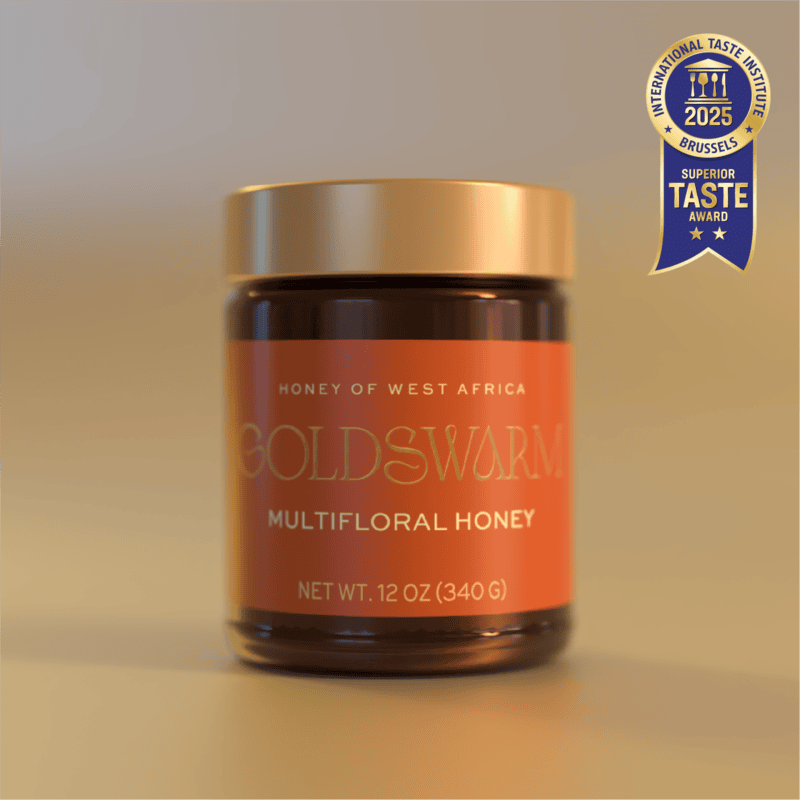
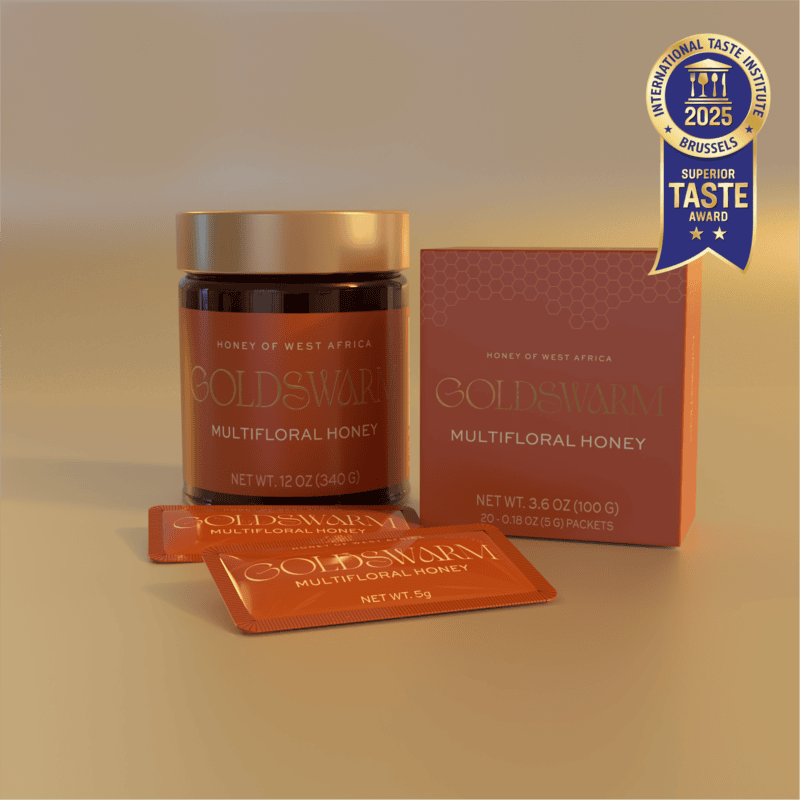
The "raw" label generally speaks to minimal processing, but it does not tell you much about origin, floral source, or traceability. Goldswarm sources from smallholder beekeepers in West Africa, where colonies forage across indigenous wildflower habitat rather than monocrop fields. Each batch is traceable to its forage zone. For fermentation, that traceability translates into batch consistency: you know what your jun's substrate will taste like next time, because you know what the honey tasted like this time.
Ready to brew? Goldswarm raw single-origin West African wildflower honey is harvested without thermal pasteurization, preserving the enzymes and microflora that jun fermentation depends on. Single-origin means consistent flavor batch to batch, and a substrate you can build a brewing routine around.
FAQ
Do I have to use a special SCOBY to make jun?
For Path A (honey in primary fermentation), yes. A jun SCOBY has been adapted to ferment raw honey and tolerate the low-level hydrogen peroxide that raw honey produces in solution. A standard kombucha SCOBY will work for one or two batches but will weaken or die over repeated honey ferments. For Path B (honey in second fermentation only), a regular kombucha SCOBY is fine, the SCOBY has been removed from the liquid by that stage.
Can I use pasteurized honey for jun?
Technically yes, but you lose most of the point. Pasteurized honey has been heated enough to deactivate the glucose oxidase, diastase, and invertase that contribute to jun's flavor development and to honey's documented health benefits. Pasteurized honey will ferment, but the result is flatter and less interesting. If you're going to brew jun at all, the cost-per-batch difference between processed honey and raw honey is small enough to not justify the trade-off.
Does the variety of honey change the flavor of jun?
Substantially. Floral source determines the aromatic profile of finished jun. Single-origin honey from a defined forage zone, like West African wildflower, produces a more predictable, batch-to-batch consistent flavor than a blended multifloral honey from unknown sources. Many jun brewers cycle through different honeys deliberately to get different finished beverages from the same SCOBY.
Where can I buy raw honey for jun?
The criteria are: raw (never pasteurized or heat-processed), single-origin (so flavor is consistent across batches), traceable to a known forage zone, and unblended. Goldswarm's West African wildflower honey meets all four. Local farmers' market honey can also work if the beekeeper confirms the processing temperature.
Is jun tea safer than kombucha to brew at home?
The safety profile is essentially the same. Both are acidic ferments (final pH typically 2.5-3.5) that resist most pathogens once the fermentation is underway. The main risk in either is contamination during the first day, before pH drops, which is why both recipes include starter liquid up front. If you see fuzzy, colored mold growing on the surface of the SCOBY (green, black, blue, or pink), discard the entire batch including the SCOBY. Normal new SCOBY growth is cream-colored, smooth, and may appear stringy in places, that is the culture, not mold.
For home brewing, use clean equipment, food-safe glass, starter liquid, and pH strips if possible. A finished ferment should be acidic enough to be safe, but not so acidic that it becomes unpleasant or harsh.
Can I make jun tea without alcohol?
No fermented tea is completely alcohol-free. Both jun and kombucha typically finish between 0.3% and 0.8% ABV. Longer ferments produce more alcohol; refrigeration arrests it. If a strictly zero-alcohol beverage matters, fermented tea is not the right category. Home-brewed batches can vary, especially with longer fermentation or extended bottle conditioning.
How does jun compare to kombucha for daily drinking?
Both contain similar live cultures, similar polyphenols from the tea, and similar small amounts of organic acids. Jun is generally lower in caffeine (green tea base) and has a softer, more floral profile. Kombucha is sharper, more vinegary, and more strongly flavored. Choice tends to come down to personal taste rather than health profile.
Technical Brewing Data
|
Parameter
|
Jun Tea
|
|
Primary fermentation temperature
|
70-80°F (21-27°C)
|
|
Primary fermentation time
|
3-5 days
|
|
Starting Brix (sweetened tea)
|
~6-7°
|
|
Finishing Brix
|
~2-3°
|
|
Starting pH
|
4.0-4.5
|
|
Finishing pH
|
2.8-3.3
|
|
Final ABV
|
0.3-0.8%
|
|
Final CO₂ (after F2)
|
2-3 volumes
|
|
Honey-to-tea ratio
|
1 cup honey per 1 gallon tea
|
|
Starter liquid ratio
|
10% of total volume
|
|
Tea steep temperature
|
175°F (80°C)
|
|
Tea steep time
|
4-6 minutes
|
|
Maximum tea temperature when adding honey
|
85°F (29°C)
|
References
3. Ahmed A, Tul-Noor Z, Lee D, et al. Effect of honey on cardiometabolic risk factors: a systematic review and meta-analysis. Nutrition Reviews . 2023;81(7):758-774. doi:10.1093/nutrit/nuac086
4. Atkinson FS, Cohen M, Lau K, Brand-Miller JC. Glycemic index and insulin index after a standard carbohydrate meal consumed with live kombucha. Frontiers in Nutrition . 2023;10:1036717. doi:10.3389/fnut.2023.1036717
5. Kapp JM, Sumner W. Kombucha: A systematic review of the empirical evidence of human health benefit. Annals of Epidemiology . 2019;30:66-70. doi:10.1016/j.annepidem.2018.11.001
6. Tu C, Tagliaro Jahns A, Mortensen MS, et al. Modulating the human gut microbiome and health markers through kombucha consumption: a controlled clinical study. Scientific Reports . 2024;14:30094. doi:10.1038/s41598-024-80281-w
7. Dosage exploration of the effects of honey and its derivatives on cardiometabolic outcomes: an overview of systematic reviews and GRADE-assessed updated meta-analysis. Nutrition & Diabetes . 2025. doi:10.1038/s41387-025-00403-9
8. USDA Agricultural Research Service. FoodData Central, Honey. https://fdc.nal.usda.gov/