

Honey Lip Scrub: How to Make It at Home (and Why Raw Honey Works Best)
A simple two-ingredient honey lip scrub for soft, smooth lips and the science behind why raw, unprocessed honey makes all the difference.


Two natural sweeteners, two very different ingredients. A side-by-side comparison from the team at Goldswarm.
Honey and agave look similar in the bottle and behave similarly on a spoon: both are amber, both are sweet, both are pourable. That is where the similarity ends. They come from different organisms, carry completely different aromatic profiles, and behave differently in baked goods, cocktails, and cold drinks. Treating them as interchangeable is one of the most common mistakes home cooks make.
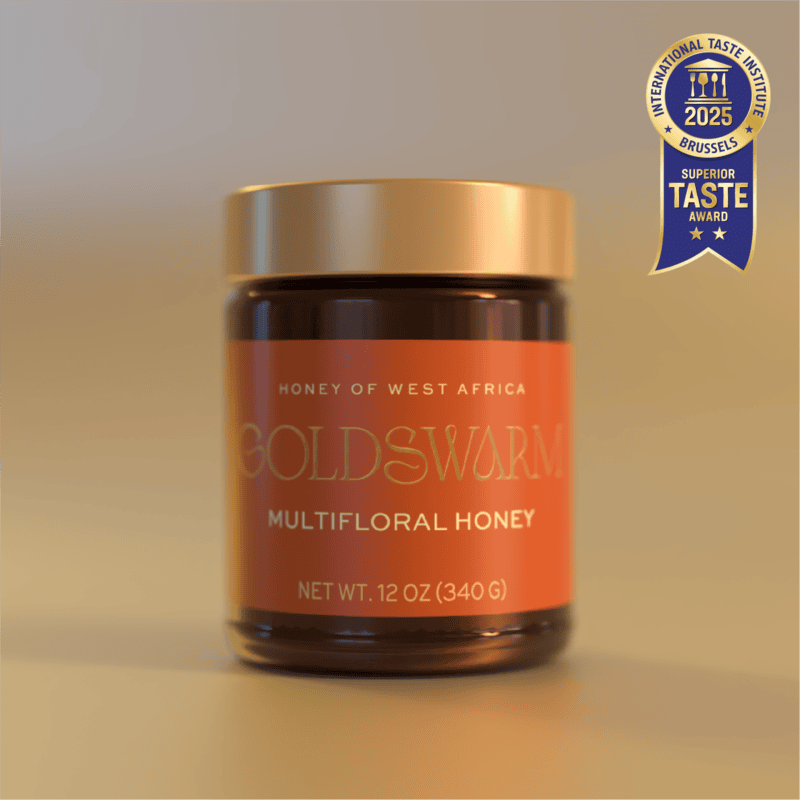
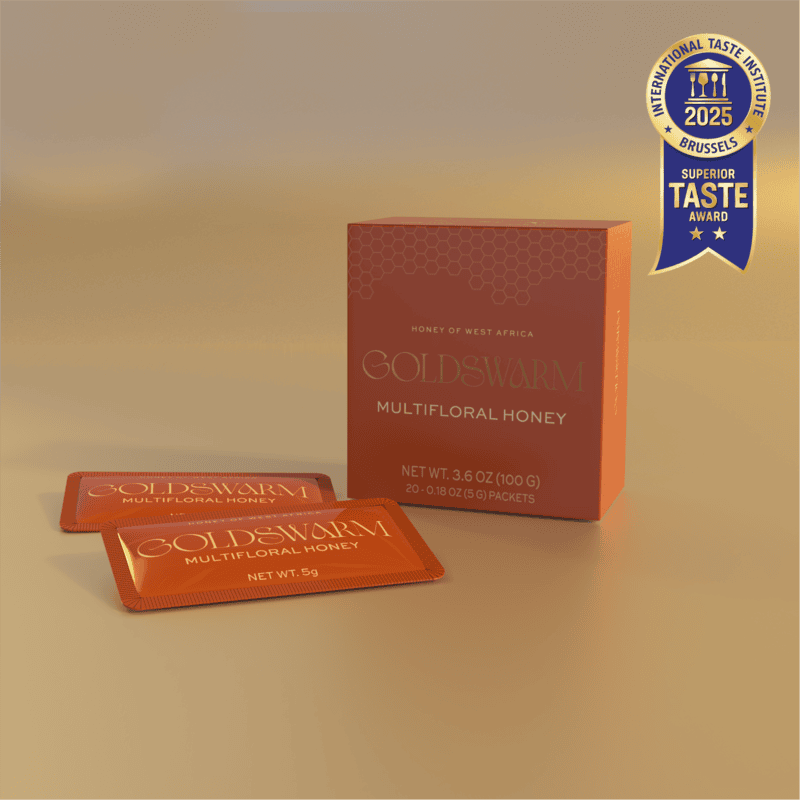
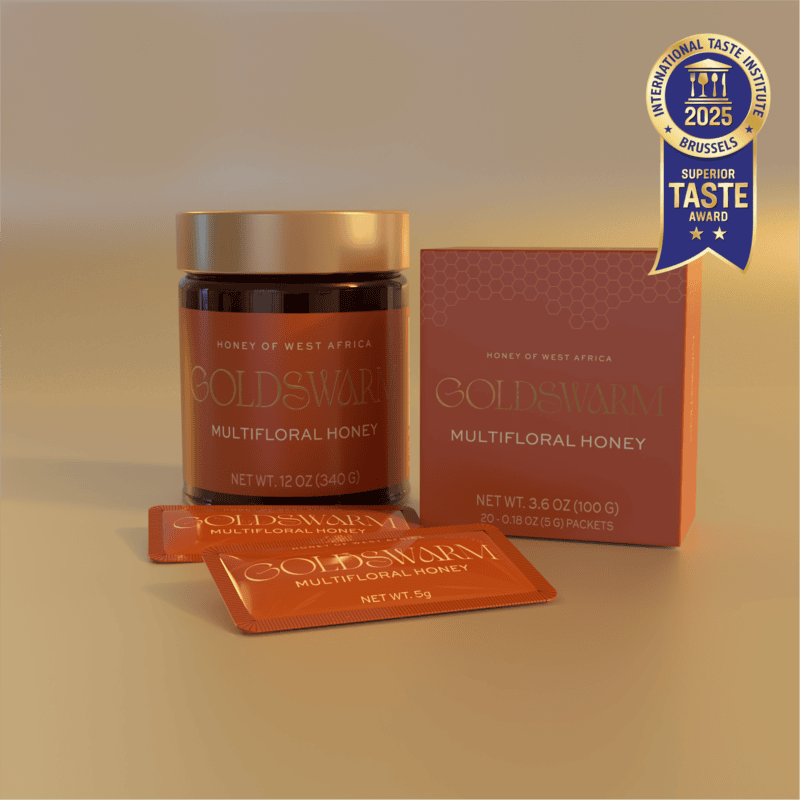
At Goldswarm, we work with raw, single-origin honey harvested in West Africa, where bees forage across wildflowers. That floral identity is the entire point of buying honey rather than a generic sweetener and it is the reason a thoughtful comparison with agave matters. This guide breaks down what each one actually does in the kitchen so you can choose with intent.
Honey is roughly 25 to 30% sweeter than granulated sugar, hygroscopic, and slightly acidic. Established conversion guidance from professional baking sources:
Agave is sweeter than sugar (about 1.4 times), more neutral in flavor, and very fluid. The conversion is similar to honey with a few tweaks:
Honey is excellent in spice cakes, gingerbread, honey cakes, baklava, banana bread, oat cookies, scones, and cornbread any recipe where its aromatic profile is part of the design.
Agave is best in recipes where you want sweetness without adding flavor: delicate vanilla cakes, pavlovas (with adjustments), fruit-forward sorbets, and the occasional vegan bake where honey is off the table for ethical reasons.
Both struggle in: meringues (the liquid prevents stiff peaks), traditional shortbread (which needs dry sugar for structure), and any recipe where precise sugar crystallization defines the texture.
| Application | Honey wins when… | Agave wins when… |
|---|---|---|
| Cold drinks | You want flavor + sweetness in hot tea or warm cocktails | You want fast-dissolving sweetness in iced tea, lemonade, or cold cocktails |
| Cocktails | Bee's Knees, Gold Rush, Penicillin, Whiskey Smash (use 1:1 honey syrup) | Margaritas, Palomas, Tommy's Margarita, tiki drinks where agave is traditional |
| Vinaigrettes & marinades | Lamb, harissa-glazed chicken, mustard-honey dressings | Light citrus vinaigrettes where you want sweetness without floral interference |
| Glazes | Salmon teriyaki, glazed carrots, hot wings, cornbread | Rarely the right choice because agave is too thin to grip a surface well |
| Cheese & charcuterie | Drizzled on aged Manchego, blue cheese, ricotta, halloumi | Not a natural fit; honey is the traditional pairing for a reason |
| Vegan applications | Not applicable (honey is an animal product) | Plant-based pancakes, granola, vegan baking |
Agave's main structural advantage over honey is that it is plant-based, which makes it acceptable to people who avoid all animal products. That is a real and legitimate reason to choose agave. For anyone else, the choice is purely culinary.
A common misconception: agave is sometimes assumed to be a more "ethical" sweetener overall. Honey production at the scale Goldswarm operates small-batch, traceable, and produced in partnership with local West African beekeepers, supports pollinator populations and the rural beekeeping economies that protect them. Ethically sourced raw honey is one of the more biodiversity-positive sweeteners available.
This is a culinary guide, not medical advice. According to USDA FoodData Central, one tablespoon of honey (~21 g) provides about 64 calories and ~17 g of sugar. Agave syrup provides a similar 60–64 calories per tablespoon and about 14 g of sugar.
The notable composition difference is in fructose content. Honey is typically around 38–40% fructose with a comparable level of glucose. Agave syrup is dominated by fructose (commonly 70–90%) because the production process converts plant fructans into fructose. A scientific review published in PubMed Central notes that agave syrups contain at least 60% fructose by total soluble solids. That is the source of agave's lower glycemic index (often reported in the 10–20 range, versus 58–61 for many honeys) and also the source of the metabolic concerns dietitians have raised about it: excessive fructose intake is associated with insulin resistance and non-alcoholic fatty liver disease. Both should be used in moderation within the USDA's added-sugar guidelines.
Honey is made by bees from flower nectar, evaporated and enzymatically transformed inside the hive. The flavor and aroma are inherited directly from whatever the bees foraged. A wildflower honey from West Africa and a clover honey from Iowa are botanically different products, even though both are labeled "honey."
Goldswarm's honey is raw and traceable to specific West African forage zones. "Raw" matters: the honey is not heated above hive temperature, so volatile aromatic compounds, pollen, and naturally occurring enzymes survive intact. That is the difference between a honey that tastes like generic sweetness and a honey that tastes like a place.
Agave syrup is made by extracting sap from the core of an agave plant (most commonly blue agave) and processing it. The sap on its own is not very sweet; it contains long-chain carbohydrates called fructans. To turn it into syrup, producers heat it or use enzymes to break those fructans down into simple sugars, mostly fructose. The result is a thin, pale-amber syrup that is technically a natural sweetener but is also industrially processed.
This matters because agave is often marketed as a "raw" or "natural" alternative on par with raw honey. In practice, the two products sit on opposite ends of the processing spectrum: raw honey is harvested with minimal intervention; agave syrup is the end product of a deliberate enzymatic or thermal conversion process.
Honey's flavor comes from volatile aromatic compounds inherited from the nectar source. Light honeys (acacia, orange blossom) read as delicate and faintly citrus. Dark honeys (buckwheat, chestnut, many African wildflower honeys) read as malty, caramelized, sometimes with smoke or molasses on the finish. A good raw honey carries a long aromatic finish that lingers after the sweetness has faded.
Goldswarm's West African honey sits on the bolder end: warm caramel up front, indigenous wildflowers in the mid-palate, and a long earthy-resinous finish. It is honey with a recognizable identity.
Agave syrup tastes primarily of sweetness. Light agave is the most neutral, closer to simple syrup with a faint vegetal edge. Amber and dark agave pick up gentle caramel and molasses notes from longer processing. None of them carry the kind of layered aromatic complexity that defines a good raw honey.
That neutrality is precisely why agave is popular in cocktails and cold drinks: it sweetens without contributing competing flavors. It is also why agave is the wrong choice when you want a sweetener that is itself part of the dish.
This is where honey and agave diverge most visibly. They behave like different ingredients on the spoon, on the plate, and in the mixing bowl.
| Property | Raw Honey | Agave Syrup |
|---|---|---|
| Water content | ~17–18% | ~22–26% |
| Viscosity at room temp | Very thick; pulls into a ribbon | Thin; pours freely, closer to maple syrup |
| Solubility in cold liquid | Resists dissolving; needs a 1:1 simple-syrup conversion or warm liquid | Dissolves easily in cold drinks; a frequent reason mixologists choose it |
| Crystallization over time | Crystallizes naturally, a sign of authenticity | Stays liquid; rarely crystallizes |
| Perceived sweetness | ~25% sweeter than table sugar | ~40% sweeter than table sugar (so you use less) |
Practical consequence: honey is the better choice for glazes and finishes where you want the sweetener to grip the surface. Agave is the better choice for cold cocktails, iced tea, vinaigrettes, and anything where rapid solubility matters more than coating power.

Close to it, but not exactly. Agave is slightly sweeter than honey and noticeably thinner. If you swap honey for agave by volume, you may want to add a teaspoon or two of liquid back into the recipe; if you swap agave for honey, expect a sweeter, thinner result. Cocktails are the easiest swap; baked goods need more adjustment.
Agave has a lower glycemic index than most honeys, which is sometimes cited as a reason for diabetics to prefer it. The catch is that agave's low GI is a direct consequence of its very high fructose content, which carries its own metabolic concerns when consumed in quantity. Neither is a free pass, and any decision here should be made with a clinician rather than a blog.
Agave is plant-derived, which makes it natural in the broad sense. But the production process (heating or enzymatic treatment) to convert plant fructans into fructose is genuinely industrial. "Raw agave" labels exist but are not regulated in the way "raw honey" effectively is. If minimal processing is the value you are buying, raw honey is the more honest match for that promise.
Most U.S. supermarket honey is a blend of light-floral nectars from a handful of major producing regions and often gently pasteurized. Goldswarm's West African honey comes from a different botanical world, with native flora producing a darker, more aromatic honey with a distinct caramel-resinous finish. It tastes different because the bees ate different flowers and because we never strip that character out with heat or fine filtration.
Honey is naturally low in water and acidic, which means it does not spoil at room temperature and never needs refrigeration. If it crystallizes, warm the jar in a bowl of hot water. That is a sign of authenticity, not damage. Agave syrup is shelf-stable for about a year unopened and roughly the same once opened, though many producers recommend refrigeration after opening to prevent fermentation.
You can, and it will dissolve faster in iced tea. But you will lose the aromatic dimension that makes honey-in-tea a recognizable flavor experience. For a strong black tea, ginger-and-lemon tea, or anything with assertive spice, honey is the better culinary fit. For a clean green tea or hibiscus iced tea, agave's neutrality may be exactly what you want.
Agave has a real and specific role in the kitchen: a clean, fast-dissolving, neutral sweetener that is also plant-based. If those are the things you need, it is a sensible choice.
What agave cannot do is replace the experience of raw honey. Raw West African honey is not just sweetness. It is a sweetener with its own aromatic identity, the kind of ingredient that becomes part of the dish rather than disappearing into it. Goldswarm exists to put that identity on the table.
Try our raw African honey alongside the agave already in your pantry. Drizzle both onto plain Greek yogurt, side by side. The honey will taste like somewhere. The agave will taste like sweet. That is the comparison this article cannot make for you.