


Honey Desserts: A Sweet and Natural Delight
From honey cake and baklava to lavender ice cream, discover 11 desserts that swap refined sugar for honey's natural sweetness, plus tips for baking with it.


Halve ripe but firm peaches, oil the cut faces, and put them face down on a hot grill for four to five minutes. Do not touch them while they are there.
Add the honey after they come off the heat, not before. This is the step many recipes get wrong. Honey on a hot grill scorches and loses the aromatics you are paying for. Honey on a hot peach warms, thins, and runs into the caramelized grooves, which is the texture you actually wanted.
Serve with whipped ricotta (Path A) or coconut yogurt and toasted almonds (Path B). Flaky salt on top of either.
The canonical version. Creamy, cold, and slightly salty against hot caramelized fruit.
Ingredients
Oven method. No grill required. Halve, oil, and roast cut side up at 425°F (220°C) for 20 to 25 minutes, until the edges brown and the fruit gives easily. You lose the char but keep the concentration. Honey still goes on afterwards.
Same fruit, same method, different landing. This version is slightly less rich and lets the peach sit further forward.
Ingredients
Method
Why the almonds. Coconut yogurt is softer and looser than whipped ricotta, so the dish loses some structural contrast. The almonds put it back. Skip them and this version reads as slightly one-note next to Path A.
Fully dairy-free and no yogurt at all? The peaches with honey and salt on their own are genuinely good. Add a squeeze of lemon to keep it from going flat.
This is not an arbitrary pairing. Both sides are carrying floral aromatics, and they overlap rather than compete.
The compound that makes a peach smell like a peach is gamma-decalactone, and it has a remarkably low detection threshold, which is why a good peach announces itself across a room. It develops as the fruit ripens rather than being present from the start.
Honey brings its own floral compounds, picked up from whatever the bees foraged. Our West African wildflower honey leans warm and floral rather than sharp, which means it sits alongside the peach instead of covering it. A more aggressive honey would flatten the fruit.
Heat is the third element. Grilling concentrates the peach and caramelizes its sugars at the cut face, which deepens everything and adds a faint bitterness that keeps the whole thing from being cloying.
The whole dish is built on contrast, and the contrast is temperature before it is anything else.
The cut face of the peach comes off the grill firm and slightly caramelized, with a faint bitterness at the char marks. Directly under that, the flesh has gone soft and loose and considerably juicier than it was raw, because heat has broken down the cell walls. So the first bite gives you resistance and then collapse, in that order.
The honey behaves differently on hot fruit than it does on cold. It thins immediately, runs into the grill marks, and then thickens again as the peach cools, so the texture shifts across the time you spend eating it. Early bites are glossy and loose. Later ones are stickier and more concentrated.
Cold whipped ricotta is the counterweight. Whipping breaks the graininess and gives you something closer to a loose cream than to cheese, which spreads under the fruit instead of sitting next to it. The coconut yogurt in Path B is looser still and cooler on the palate, which is why the toasted almonds matter there: without something crisp, that version has no hard edges anywhere.
Flaky salt is not a garnish. Placed on top, it dissolves unevenly, so you get occasional bright points of salt against the sweetness rather than a uniform seasoning. Fine salt stirred in does not do this.
Three things worth knowing before you light the grill.
Honey does not do well with direct heat. On a hot grill it loses the delicate aromas you are paying for, and because it is mostly sugar, it scorches fast into something bitter rather than caramelizing. Adding it to the fruit afterwards avoids both problems: the residual heat of the peach is enough to thin the honey so it flows and clings, and nowhere near enough to damage it.
If you want the lacquered look, brush a thin layer of honey on during the final thirty seconds, off direct flame. You trade a little aroma for appearance, which is fine as long as you are doing it on purpose.
Freestone peaches release cleanly from the pit. Clingstone peaches do not, and trying to halve one for the grill produces a mangled cut face that will not caramelize evenly. Most peaches sold fresh in mid to late summer are freestone. If the flesh fights you, you have a clingstone; slice around the pit instead and grill the wedges.
Ripeness matters just as much. A peach that is soft enough to eat over the sink will collapse on the grill. You want fruit that yields slightly at the shoulder but still holds its shape when you press it. Underripe is the safer error here, because heat will soften it.
Peaches are climacteric, which means they continue to develop after picking. What changes most is not sweetness. During post-harvest storage, the green, grassy C6 compounds drop away rapidly while lactones, the peach-scented ones, rise sharply (Yang et al., 2019).
The practical version: a hard peach left on the counter for two or three days will smell dramatically more like a peach, even if it does not taste much sweeter. It is best to let unripe peaches ripen at room temperature, since the cold of the fridge slows this process down and can leave the fruit mealy. Once they are ripe, refrigerating them is fine to buy a few more days.
Per serving, Path A, based on four servings. Values from USDA FoodData Central; actual figures vary with peach size and ricotta brand.
| Per serving | |
| Calories | ~235 kcal |
| Total carbohydrate | ~29 g |
| Sugars | ~27 g |
| Fiber | ~2 g |
| Fat | ~10 g |
| Protein | ~8 g |
| Sodium | ~60 mg, plus finishing salt |
Path B runs slightly lower in protein and slightly higher in fat, depending on the coconut yogurt. Roughly 250 kcal per serving with the almonds included.
Most grilled peach recipes call for brown sugar, either sprinkled on the cut face before grilling or stirred into butter as a glaze. Converting to honey is not a straight swap, and the reason is the whole point of this post.
Brown sugar can go on before the heat. Honey should not. Sugar sprinkled on a cut peach caramelizes into a crust. Honey brushed on the same peach scorches. If you are adapting a recipe that puts sugar on early, move the honey to the end rather than substituting in place.
For quantity, start with about 3 tablespoons of honey where a recipe calls for 4 tablespoons of brown sugar, then adjust. Honey is generally sweeter than sugar per gram (the commonly quoted range is somewhere between 1.2 and 1.5 times), but that figure shifts with the honey's sugar profile and with what you are pairing it against. Taste before you commit to more.
What you gain and lose. Brown sugar gives you a hard caramel crust and a molasses note. Honey gives you floral aromatics and a softer, glossier finish that stays liquid. In this recipe honey wins, because the caramelization is already coming from the fruit's own sugars against the grate. You do not need the sugar to do that job.

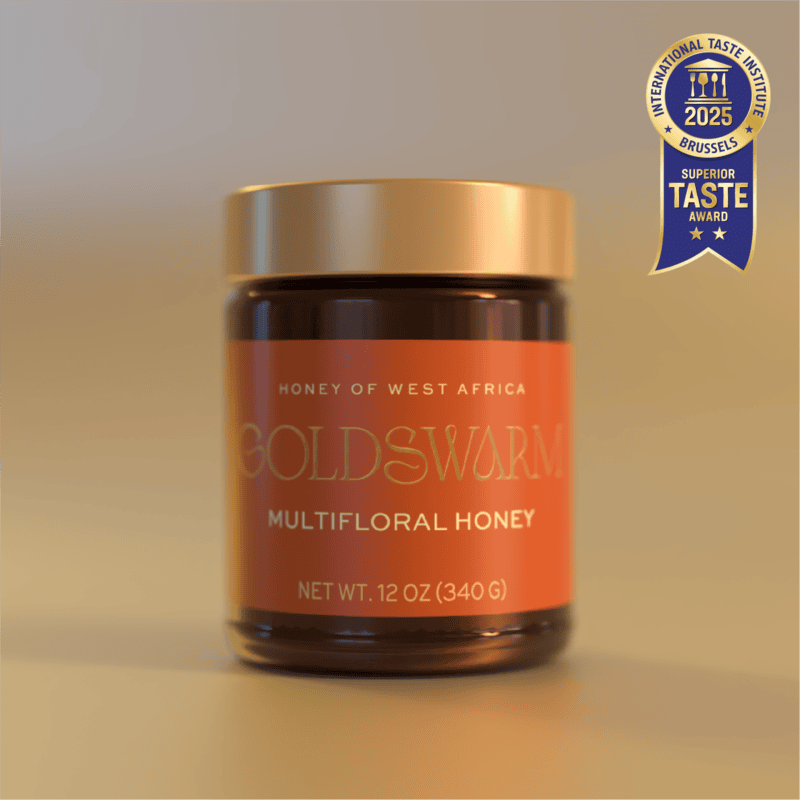
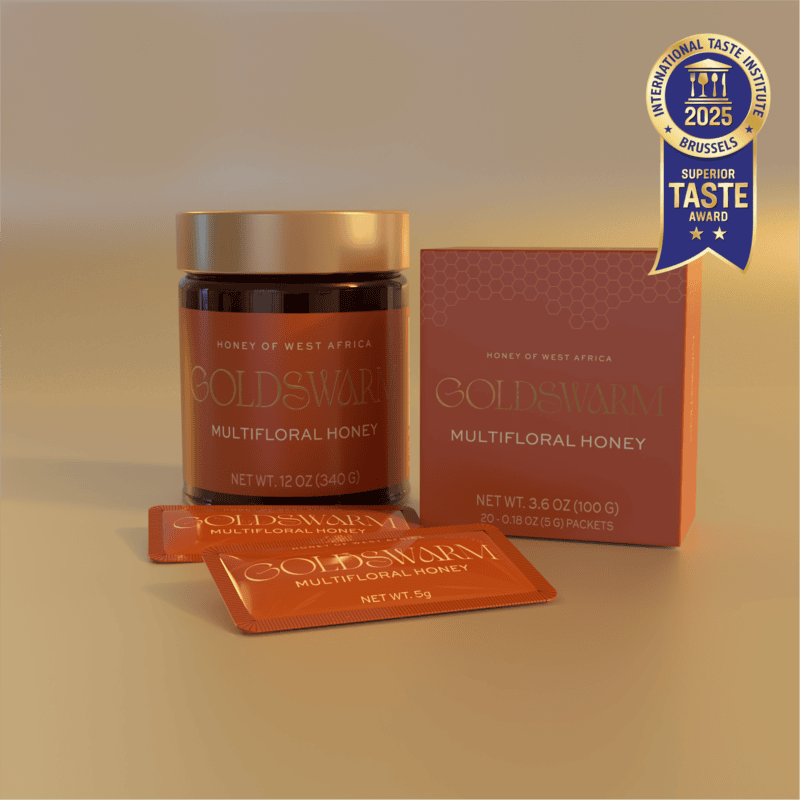
Peaches travel badly. Honey does not. Goldswarm To-Go Packets are single-serve portions of the same raw, single-origin West African wildflower honey, for the cabin, the campsite, or whatever fruit you find at the farm stand on the way. (Link to product page, pending.)
Freestone, ripe but firm. Freestone peaches release from the pit cleanly, which gives you a flat cut face that caramelizes evenly. If the flesh clings to the pit, cut wedges around it and grill those instead.
Yes, and they behave almost identically. Nectarines have no fuzz and slightly firmer flesh, so they hold their shape a little better. Apricots also work; halve the grilling time, because they are much smaller.
Leave them on the counter, out of the fridge, for two to three days. They will soften and develop considerably more aroma. Do not refrigerate them in the meantime, because cold interrupts ripening and gives you mealy fruit.
Two reasons. Heat degrades honey's aroma compounds and enzymes, and at grill temperatures the sugars scorch into something bitter rather than caramelizing. Adding it after gives you the flavor and the glossy finish without either problem.
Stand the jar in a bowl of warm water for a few minutes. If it has crystallized, the same approach works, just give it longer. Crystallization is normal and does not mean the honey has gone bad.
Yes. Roast cut side up at 425°F (220°C) for 20 to 25 minutes. A cast iron pan on high heat also works well and gives you a good sear on the cut face.
The whipped ricotta, yes, up to two days refrigerated. The peaches, no. They should go from the heat to the plate. Grilled peaches held for an hour lose their texture entirely.
Not with the honey. Honey should never be given to infants under 12 months, in any form, because of the risk of infant botulism. Grilled peach on its own is fine.
| Yield | 8 peach halves, 4 servings |
| Prep time | 10 minutes |
| Grill time | 5 to 7 minutes total |
| Oven alternative | 425°F (220°C), 20 to 25 minutes |
| Grill temperature | 400 to 450°F (200 to 230°C), medium-high |
| Peach type | Freestone, ripe but firm |
| Honey added | After heat, always |
| Make ahead | Ricotta yes (2 days); peaches no |
| Leftovers | Not recommended; texture does not survive |
| Scaling | Scales linearly, limited only by grill surface |

